
Mortal Kombat 2 story
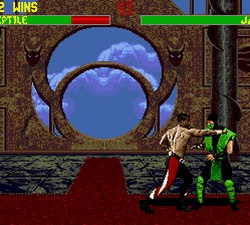
The story of Mortal Kombat II is that rare follow-up that didn’t just lock in a win—it became a legend on its own. In the arcades the first punch had already landed: crowds ringed the cabinets, quarters clinked, and someone over your shoulder always hissed, "watch—fatality incoming." But the Midway crew didn’t kick back. They took that gravelly, defiant tone of the original and cranked it up across the board: from the Outworld mythos to a fresh fighter gallery where Kitana, Mileena, Baraka, and Kung Lao now stood alongside Scorpion and Sub‑Zero. Mortal Kombat II sprang from a need to make the tournament nastier and the story tighter. You feel it from fight one: instead of a contest torn between realms, you’re hurled straight into Shao Kahn’s lair, where the air itself is heavy with hatred and a conqueror’s pride.
In MK2 the world suddenly felt bigger. Yesterday it was Shang Tsung’s mysterious island; today it’s Outworld, where a forest whispers with human faces and chains scream above the arena. These stages aren’t just wallpaper. Living Forest, The Dead Pool, The Pit II—each one is a scene with its own lore. Trees stare back with hollow sockets, acid flashes an emerald blaze, and a spike pit reminds you: this tournament is about survival. No lectures—you get it in your spine. That’s why, call it Mortal, MK, or Mortal Kombat II, it goes down easy and grips hard.
How the sequel came to be
The first game’s success gave the team a mischievous swagger. Ed Boon and John Tobias didn’t hide behind spreadsheets; they saw players lock down inputs, bargain for cabinet time, and argue who was cooler—Liu Kang or Rain… hold up, Rain’s later. The real job was finding a new rhythm. Mortal Kombat II layered in drama without words: brought back a rejuvenated Shang Tsung, raised the stakes from Goro to Kintaro, and at the top, Shao Kahn flashing that predatory grin. It’s not "just another tournament"—it’s an invasion, where every win is a step toward the tyrant’s throne.
At the same time, Mortal Kombat II on the Sega Genesis didn’t try to please everyone. It stayed an uncompromising fighter with a personality: sharp, a little smug. That "Toasty!" after a crisp uppercut is proof the game isn’t afraid of its own audacity. It winks at you without cooling the heat. And that’s how a culture forms: whispers of the secret Jade fight, rumors about the mysterious Noob Saibot, the smoky outline of Smoke—traded at recess, in neighborhood clubs, and in buzzing arcades.
Why players fell for it
MKII nailed a rare combo: spectacle and myth. Liu Kang isn’t just the hero pose anymore—you feel the responsibility on his shoulders. Kitana and Mileena are two sides of Edenia’s story under Shao Kahn’s boot. Reptile finally steps out of the shadows—no longer a hidden cameo but a full combatant. Jax is muscle and cool nerve. You can hear it in the crowd’s reaction to a Friendship or a Babality. Silly? Absolutely. But that’s exactly what makes the universe feel alive: after a brutal Fatality, the game lets you smile. You’re not just grinding for a W—you’re walking into a world where everyone wears a mask, and a scar beneath it.
Secrets and "codes and moves" traveled by word of mouth faster than magazines ever could. Someone swore they watched a rival melt away in The Dead Pool’s acid. Someone else bragged about landing a stage fatality in the spiked well. Today it reads like a feature list; back then it was straight‑up magic. Mortal Kombat II fed on rumors, and every rumor made it stronger. Whether you called it Mortal Kombat II, MK2, or just Mortal, you knew this: there’d be a rematch tonight, and this time you’d nail that finishing move.
The vibe around that Sega cartridge was a story of its own. The market stall, the crinkly shrink‑wrap, the jagged logo, and the promise of blood parents argued about. At home—first boot, the brassy title hum, those familiar silhouettes, and then the call: "Fight!" Some picked Liu Kang for the flying kick, some turtled with Sub‑Zero, others learned Scorpion’s teleport. In that same room, friendship was forged: a two‑player brawler where your neighbor whispers "go uppercut," and you grin, waiting for that "Toasty!" It wasn’t about pixels—it was about solidarity and a rush that never faded.
With each new day, MKII gathered more stories. Arcades buzzed about players who cleared the ladder without a loss; courtyards hosted "first to two losses" brackets on a wobbling stool with rattling pads. We weren’t debating frame data or balance patches. We argued like our lives depended on it—was Shang Tsung with morphs stronger, or Kung Lao with that trusty hat? We fought over it as if Outworld’s future hung in the balance. And beneath the chatter, Shao Kahn’s throne room rumbled: the game always had a voice—confident, weighty, unmistakable.
Most of all, Mortal Kombat II became the anchor that moored the series in our hearts. It proved a fighter can tell a story not with cutscenes, but with a sense of place. That a "secret match" isn’t just fan service—it’s part of the legend. That a cheeky "bet you won’t end it with a Friendship?" matters as much as the roar after Kintaro. That’s why we still talk about it warmly—as the older brother who ushered us into Mortal Kombat, taught us the rules, let us smell Outworld’s air, and showed us how to savor not only victory, but a beautiful moment.
And when you spot that old cartridge on the shelf, your hand just reaches out. Because Mortal Kombat II isn’t only a "classic fighter" or "arcade classic." It’s cultural shorthand, where "Fight!" is the bell for recess, "Finish Him!" reads like a proper noun, and "Toasty!" is a friend’s scrawl in the margins. Call it MK2, Mortal Kombat II, or simply Mortal—the heart answers the same way: one more round.